

Laser Therapy in Joints
Clinical insights, treatment frameworks, and business strategies for applying laser therapy to joint conditions in a modern practice.
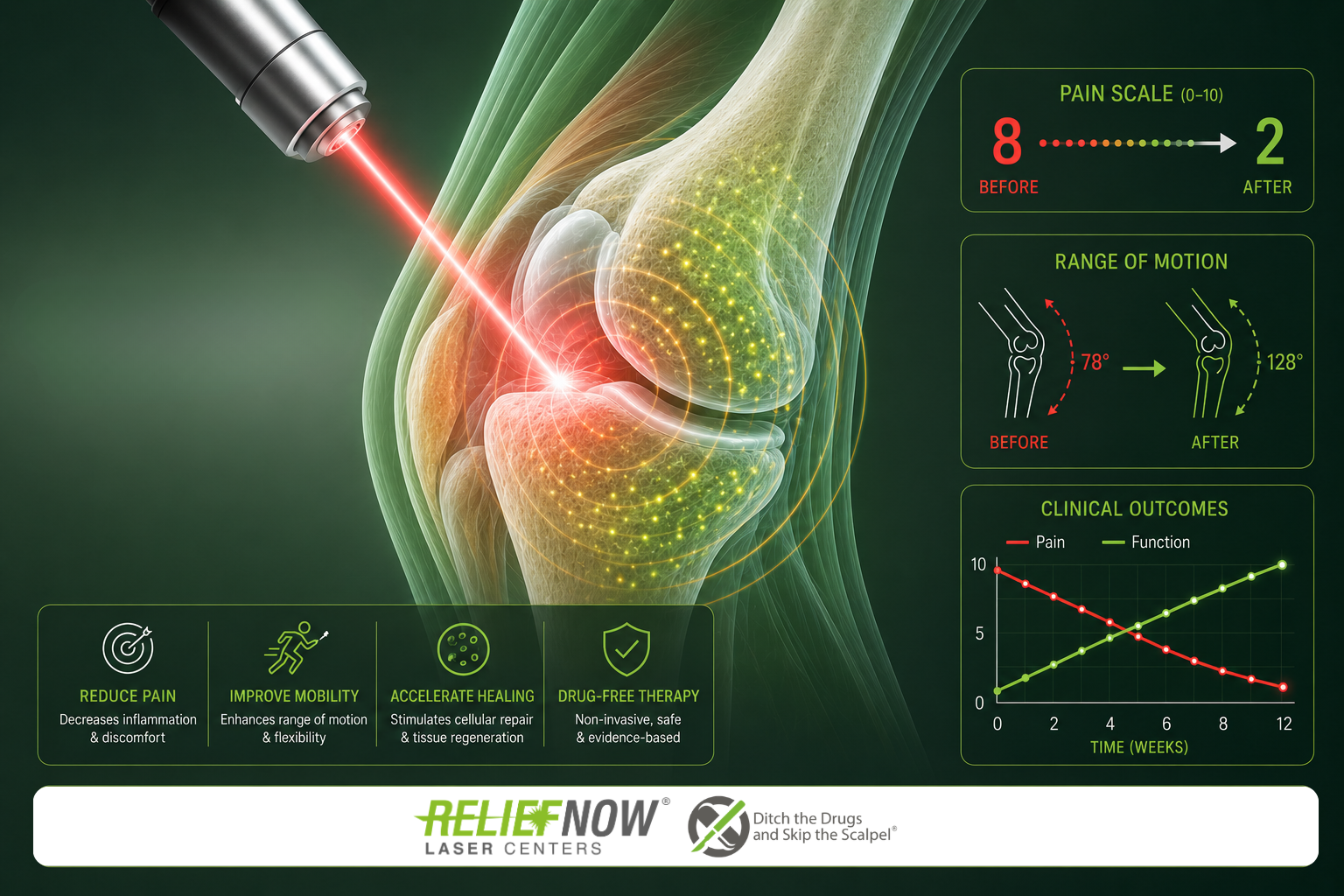 Joints
Measuring What Matters: How Outcomes-Based Care Is Transforming Non-Surgical Pain Management
For decades, the standard of care for chronic pain, peripheral neuropathy, and disc-related conditions leaned heavily on symptom management through medication or invasive procedures.
 Joints
Effects of Class IV Laser in Knee Osteoarthritis
Knee osteoarthritis (KOA) is characterized by a gradual wearing away of the cartilage in the joint through strain originating from weight bearing, repeated injury, and/or damage and is one of the most associated causes of knee pain.
Laser Therapy for Joint Pain: Frequently Asked Questions
Evidence-based answers to the most common questions about Class IV laser therapy for joint pain, arthritis, and degenerative joint conditions — from how it works to what results patients can expect.
Yes. Class IV laser therapy (photobiomodulation) is FDA-cleared and supported by over 6,000 peer-reviewed studies for musculoskeletal and joint conditions. The therapy delivers targeted wavelengths of light (810–980 nm) into joint tissue, stimulating mitochondrial ATP production, reducing pro-inflammatory cytokines, and accelerating cellular repair. Most patients report measurable pain reduction and improved range of motion within 3 to 6 sessions. Unlike pain medications, photobiomodulation addresses the underlying inflammatory and tissue pathology — not just the symptom.
Class IV laser therapy is clinically effective for osteoarthritis, rheumatoid arthritis, knee joint pain, hip joint degeneration, shoulder impingement, rotator cuff injuries, elbow tendinitis (tennis elbow, golfer's elbow), wrist and finger joint pain, and sports-related joint injuries. It works for both acute joint injuries and chronic degenerative conditions. Because photobiomodulation works at the cellular level — reducing inflammation and stimulating tissue repair — it addresses the underlying joint pathology rather than simply masking pain signals.
Laser therapy reduces joint inflammation through a cellular process called photobiomodulation. Therapeutic light at 810–980 nm is absorbed by cytochrome c oxidase in mitochondria, triggering a cascade that increases ATP production, reduces reactive oxygen species, and lowers pro-inflammatory cytokine levels — including IL-1β, TNF-α, and PGE2. The result is decreased joint swelling, improved circulation to the affected tissue, and accelerated cartilage and soft tissue regeneration — without the systemic side effects of anti-inflammatory medications or corticosteroid injections.
Most patients with joint pain begin to notice improvement within 3 to 6 sessions. A standard treatment plan involves 6 to 12 sessions delivered over 2 to 4 weeks, depending on the severity and chronicity of the joint condition. Acute joint injuries typically respond faster than chronic degenerative conditions such as osteoarthritis or degenerative disc disease. Maintenance sessions may be recommended after the initial series for patients with ongoing joint degeneration to sustain improvements and slow disease progression.
Yes. Class IV laser therapy is FDA-cleared and has an established safety profile for arthritic joints, including both osteoarthritis and rheumatoid arthritis. The treatment is fully non-invasive — no incision, no injection, no anesthesia. It carries no risk of infection, scarring, or the systemic side effects associated with long-term NSAID use or repeat corticosteroid injections. It is safe for most adults including older patients with multiple joint conditions and can be used alongside other treatments without contraindication.
For many patients, Class IV laser therapy provides sufficient pain relief and functional improvement to delay or avoid joint surgery. Clinical outcomes show meaningful improvement in patients with knee osteoarthritis, shoulder impingement, and hip joint degeneration who were otherwise considering surgical intervention. Unlike corticosteroid injections — which can degrade cartilage with repeated use — laser therapy stimulates tissue repair rather than masking pain. Patients who have been told surgery or injections are their only options are strong candidates for a laser therapy evaluation at ReliefNow® Laser Centers.
Class IV laser therapy delivers significantly higher power output — 1 to 25+ watts — compared to low-level laser therapy (LLLT) or cold laser, which typically operates under 500 milliwatts. The higher power allows Class IV lasers to penetrate deeper into joint tissue, reaching structures like the hip joint capsule, knee cartilage, and spinal facet joints that are inaccessible to low-power devices. Deeper penetration means faster treatment times (10–15 minutes) and clinically superior outcomes for deep joint conditions. ReliefNow® Laser Centers uses Class IV therapeutic lasers specifically selected for tissue penetration depth and documented clinical efficacy in joint conditions.
Ready to reduce joint pain without surgery or medication? FDA-cleared · Non-invasive · No downtime · Results in as few as 3 visits